


Learn how CEREC single visit crowns restore teeth in one appointment with digital precision, durable materials, and natural aesthetics.
Are CEREC Single Visit Crowns Right for You?
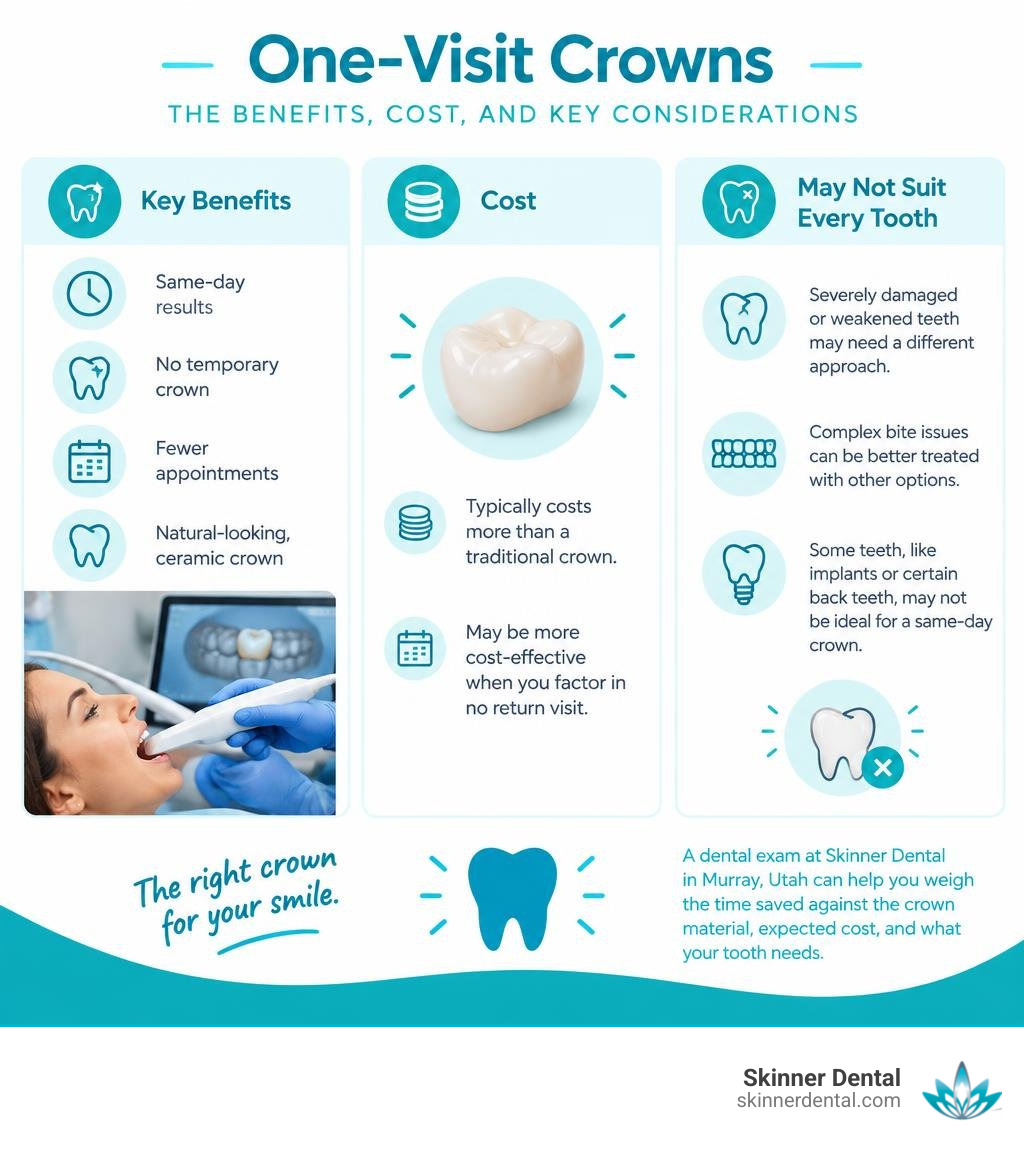
CEREC single visit crowns can restore a damaged tooth in one appointment. A dentist scans the tooth, designs and mills a ceramic crown, then fits it the same day. That means no temporary crown or return visit. The trade-off: a same-day crown may not be the best choice for every tooth or bite.
At Skinner Dental in Murray, Utah, a dental exam can help you weigh the time saved against the crown material and what your tooth needs.
What Are CEREC Single Visit Crowns and How Do They Work?
CEREC stands for Chairside Economical Restoration of Esthetic Ceramics. While that sounds like a mouthful of dental jargon, the core idea is simple: it is an advanced computer-aided design and computer-aided manufacturing (CAD/CAM) system that allows us to create, polish, and seat a durable ceramic tooth restoration in just one visit.
For over 35 years, digital dentistry has steadily evolved. Today, more than 6.5 million patients receive treatment with CEREC technology each year—a number greater than the annual visitors to the Eiffel Tower! Roughly 85% of patients express a strong preference for finishing their dental restorations in a single appointment, and CAD/CAM systems make that achievable without cutting corners on clinical precision.
The process replaces conventional physical impressions, laboratory mail-aways, and temporary acrylic caps with a fully integrated digital workflow. By taking optical scans of your prepared tooth, designing the replacement crown on a chairside 3D computer terminal, and fabricating the restoration right in our office milling unit, we can restore structural integrity and natural aesthetics in roughly one to two hours from start to finish.
Step-by-Step Clinical Procedure for CEREC Single-Visit Crowns
Getting a custom ceramic crown usually involves four distinct, seamless stages:
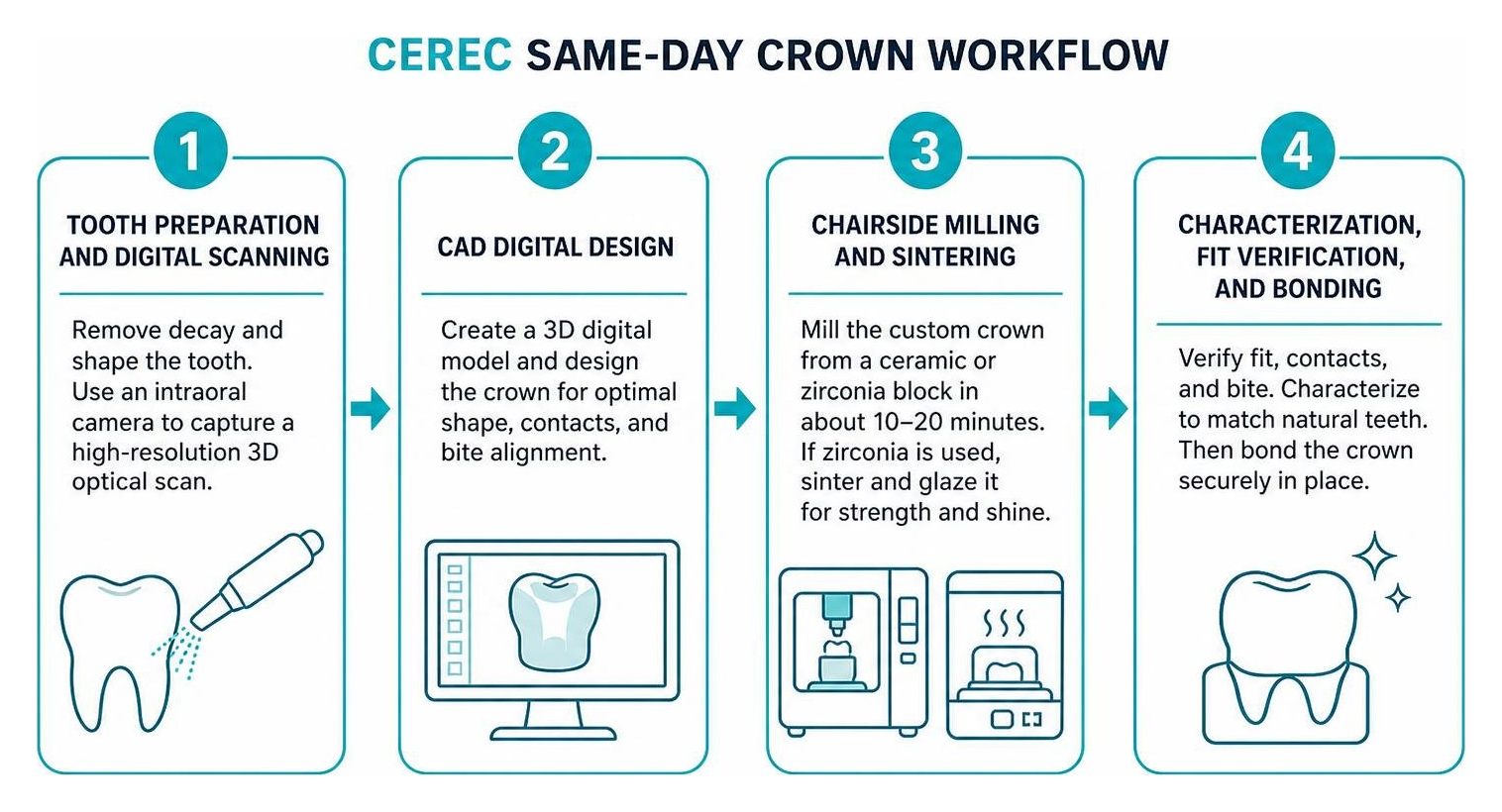
- Tooth Preparation and Digital Scanning: We begin by numbing the area to ensure you remain completely comfortable. Any existing dental decay or damaged tooth structure is removed, shaping the natural tooth to create a solid foundation for the crown. Instead of using a tray filled with gooey, gag-inducing impression putty, we glide a slim intraoral camera over your teeth. This captures a high-resolution, full-color 3D optical impression of your tooth preparation and surrounding bite.
- CAD Digital Design: The intraoral scan appears instantly on our computer screen. Using sophisticated software, we generate an exact 3D digital model of your tooth. We refine the crown’s shape, contact points, and biting grooves to align naturally with your neighboring and opposing teeth.
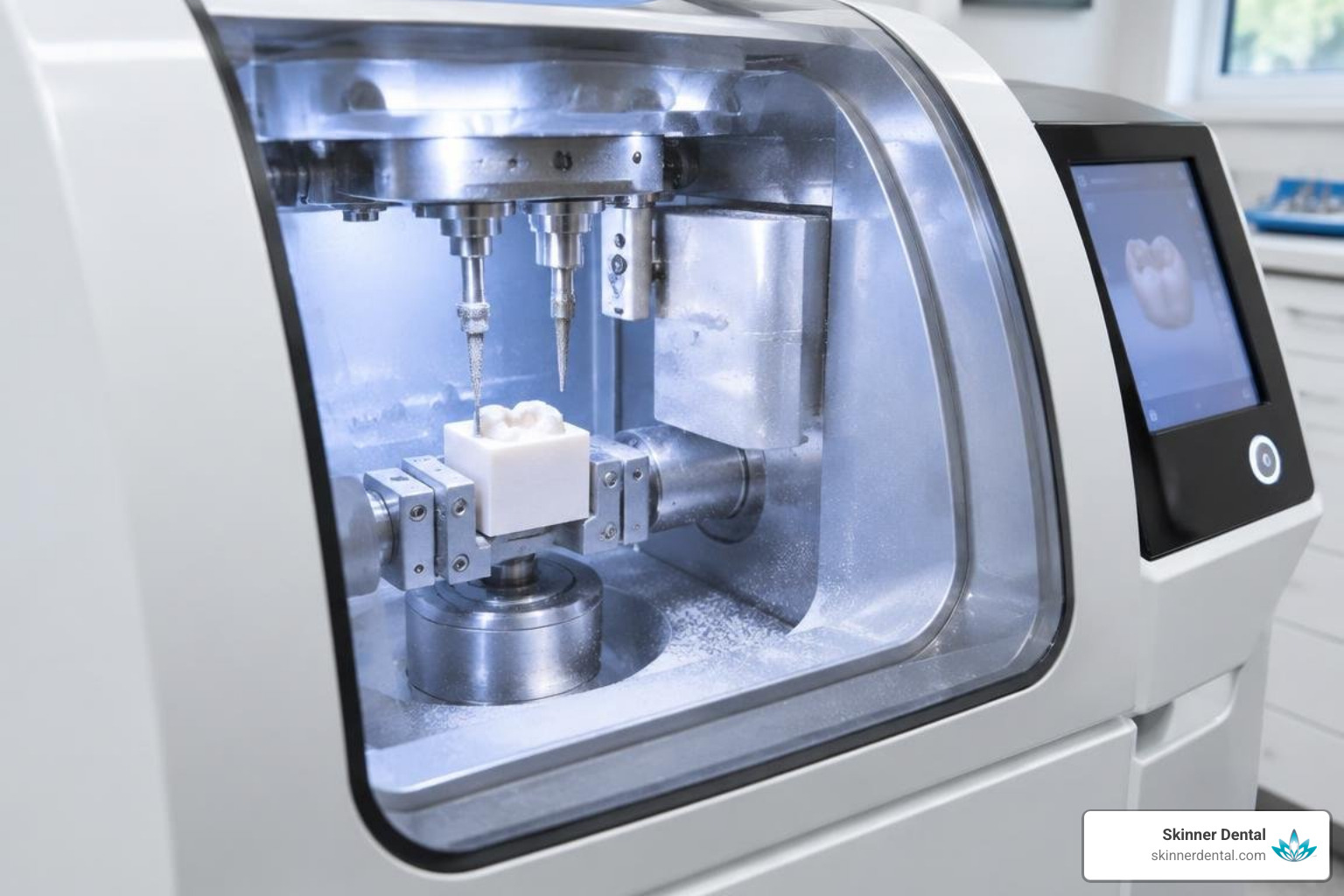
- Chairside Milling and Sintering: Once the design is finalized, the digital blueprint is sent wirelessly to an in-office milling machine. The unit uses diamond-coated burs to sculpt your custom restoration from a solid block of high-grade ceramic or zirconia in approximately 10 to 20 minutes. If zirconia is selected, the milled restoration is placed in a specialized chairside induction furnace for rapid sintering and glazing, ensuring peak strength and a natural gloss.
- Characterization, Fit Verification, and Bonding: We place the crown onto your tooth to double-check the marginal fit, contact tightness, and your natural bite alignment. We can hand-tint and characterize the ceramic to match your adjacent natural teeth. Once everything is aligned, we permanently bond the restoration into place using clinical-grade dental cement.
Comparing Same-Day Crowns to Traditional Lab-Made Restorations
Traditional laboratory crowns have served dentistry reliably for decades, but they follow a much longer path. Understanding the differences between in-office digital fabrication and multi-visit laboratory workflows helps clarify why so many patients appreciate single-visit care.
| Feature | CEREC Single-Visit Crowns | Traditional Lab-Made Crowns |
|---|---|---|
| Total Appointments | 1 single visit (approx. 1 to 2 hours) | 2 to 3 separate visits over 2 to 3 weeks |
| Impression Method | Quick, comfortable 3D optical digital scan | Physical impression trays with silicone putty |
| Temporary Crowns | Not required | Required for 2 to 3 weeks (risk of falling off) |
| Local Anesthesia | 1 initial injection session | Multiple injections across different visits |
| Fabrication Location | In-office precision milling unit | External dental laboratory |
| Fit Adjustments | Immediate digital adjustment & chairside remill | May require physical return to the dental lab |
| Long-Term Durability | Over 85% success at 10 years | Comparable clinical longevity (approx. 85–90% at 10 years) |
A notable benefit of the digital process is precision. Digital impressions eliminate the minor dimensional distortions that can happen when physical impression material sets or when stone models are poured. This provides exceptional marginal fit accuracy, reducing microscopic gaps at the gumline where plaque and bacteria could otherwise accumulate.
Evaluating Materials: Lithium Disilicate vs. Zirconia
Modern single-visit restorations rely on advanced dental materials engineered to mimic natural enamel while withstanding significant chewing forces. The two primary materials used for same-day fabrication are lithium disilicate (a high-strength glass ceramic) and monolithic zirconia.
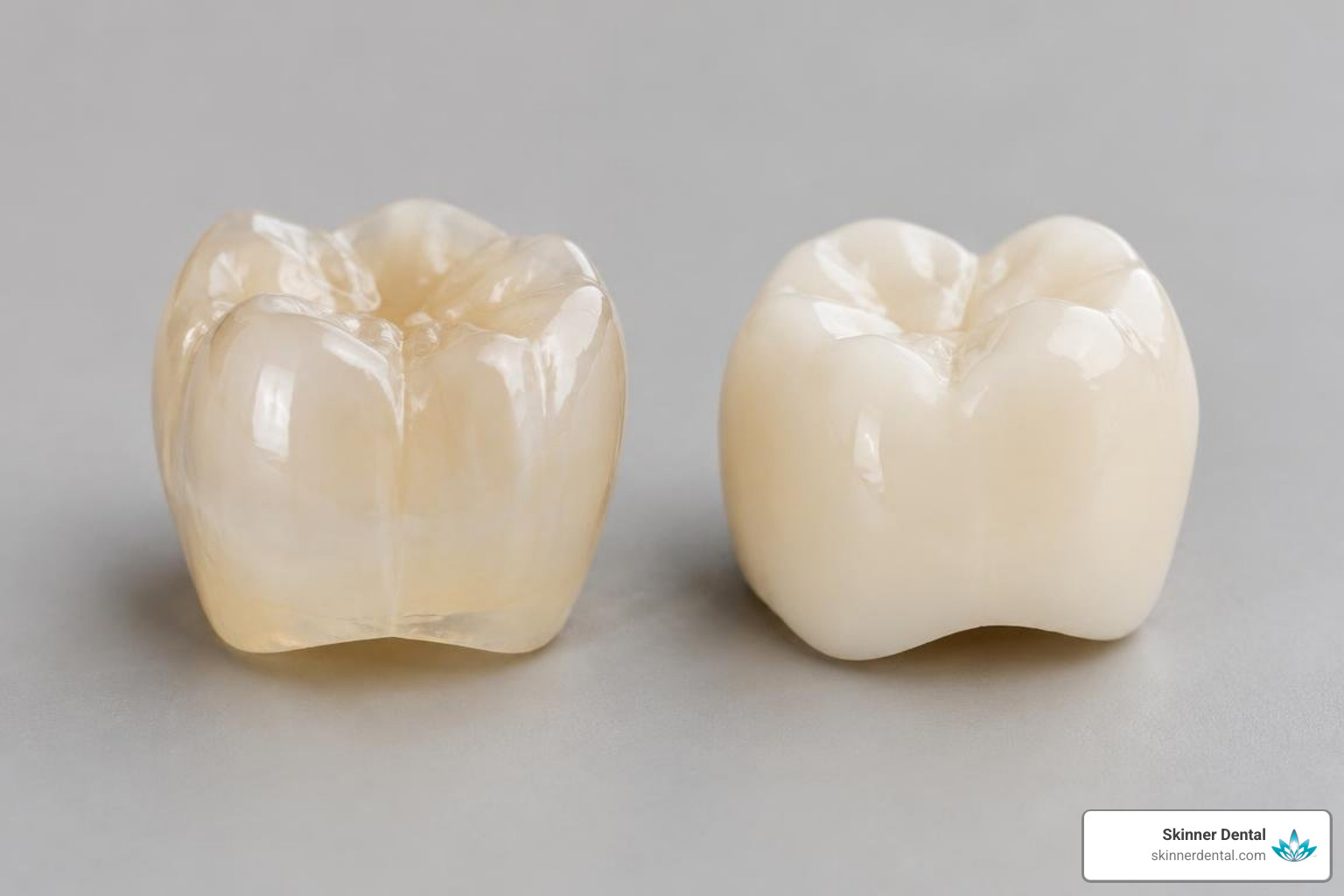
- Lithium Disilicate (such as IPS e.max): This glass-ceramic material provides exceptional translucency, reflecting and scattering light in a manner nearly identical to natural tooth enamel. With a flexural strength ranging between 360 and 400 MPa, it offers ample durability for day-to-day chewing while delivering outstanding cosmetic results.
- Monolithic Zirconia: Known for its immense toughness, full-contour zirconia boasts flexural strength exceeding 1,000 MPa. Zirconia restorations combine the conservative tooth preparation and dependable cementation of metal crowns with the cosmetic benefits of a tooth-colored ceramic and low thermal conductivity (Wiedhahn et al., 2016).
Matching Ceramic Types to Anterior and Posterior Teeth
Choosing between lithium disilicate and zirconia depends on the location of the tooth and the specific biting forces it experiences:
- Anterior Teeth and Premolars: For your front teeth (incisors and canines) and visible premolars, aesthetic translucency is the top priority. Lithium disilicate is frequently the material of choice here because it blends naturally with surrounding enamel and eliminates any dark metal lines along the gumline.
- Posterior Molars: Your back molars bear the brunt of heavy chewing and grinding, withstanding forces of several hundred pounds per square inch. For these locations, monolithic zirconia provides unmatched fracture resistance. Thanks to high-speed chairside induction furnaces, zirconia restorations can be milled, sintered, polished, and permanently bonded in a single appointment.
Clinical Performance and Trade-Offs: When Is CEREC the Right Choice?
Clinical research underscores the long-term reliability of CAD/CAM restorations. Long-term studies show that same-day ceramic restorations achieve survival rates exceeding 95% at 5 years and approximately 85% to 90% at 10 years—durability rates that match or exceed those of traditional lab-fabricated porcelain-fused-to-metal crowns.
For detailed clinical perspectives on digital restorative protocols, consulting a comprehensive same-day crown guide illustrates how in-office milling has transformed modern prosthodontics.
However, same-day crowns are not universally suitable for every dental scenario. If a tooth fracture extends deep beneath the gumline (subgingival margins) where an intraoral scanner cannot clearly capture the tooth perimeter, a traditional impression or minor gum contouring may be necessary. Similarly, complex cosmetic reconstructions involving six or more front teeth may benefit from the layered artistry of a master dental ceramist to achieve intricate shade gradients.
Key Advantages and Drawbacks of CEREC Single Visit Crowns
Advantages:
- Significant Time Savings: Complete your treatment in a single 60-to-120-minute appointment instead of taking multiple days off work.
- No Temporary Restorations: Avoid the annoyance of wearing fragile plastic temporary crowns that can dislodge, trap food, or cause gum tenderness.
- Enhanced Comfort: Optical scanners eliminate uncomfortable, messy impression trays and minimize gagging reflexes.
- Single Anesthetic Event: Receive local numbing medication only once rather than facing repeat injections weeks apart.
- Immediate Adjustments: If the marginal seal or bite requires modification, our team can refine the digital file and remill the crown chairside right away.
Drawbacks and Considerations:
- Clinical Limitations: Deep subgingival margins or teeth with severe structural damage below the bone line may require specialized surgical exposure or alternative laboratory workflows.
- Operator Skill Dependency: Successful CAD/CAM restorations depend heavily on the clinician’s expertise in digital margin design, prep geometry, and material selection.
- Complex Multi-Shade Staining: While chairside staining and glazing create lifelike results, extremely complex enamel discolorations or fluorosis patterns across front teeth may occasionally require dedicated multi-layer lab fabrication.
CEREC Full Crowns vs. Ceramic Veneers and Onlays
Restoring a tooth does not always require removing enamel for a full 360-degree crown. Modern restorative dentistry prioritizes conservative tooth preservation whenever possible. The same digital CAD/CAM technology used for full crowns can also mill partial-coverage restorations:
- Ceramic Inlays and Onlays: If a molar has a fractured cusp or large failing filling but the remaining tooth walls are healthy and strong, a CEREC onlay (often called a partial crown) can rebuild just the damaged area. A detailed clinical case analysis on partial crowns demonstrates how conservative CAD/CAM onlays resolve biting pain and temperature sensitivity while preserving healthy enamel and dentin.
- CEREC Veneers: When treating aesthetic concerns isolated to the front surface of teeth—such as severe discoloration, chipping, or minor gaps—thin ceramic veneers can be digitally designed and placed to create a uniform, bright smile while leaving the back of the tooth untouched.
Who Is the Ideal Candidate for Same-Day Restorations?
Same-day CAD/CAM restorations are an excellent solution for many common dental issues:
- Patients with Broken or Cracked Teeth: Sudden fractures from chewing hard foods or accidental trauma can be stabilized immediately, preventing bacterial infection and relieving nerve sensitivity.
- Large Failing Fillings or Extensive Decay: When an old, deteriorating amalgam or composite filling undermines tooth structure, a single-visit crown provides full structural reinforcement.
- Busy Professionals and Families: Individuals who cannot easily schedule multiple appointments, take extra time off work, or manage childcare logistics benefit immensely from one-stop dental visits.
- Patients with Strong Gag Reflexes: Those who find conventional impression trays uncomfortable can enjoy the ease of a compact, wand-like intraoral scanner.
When is an alternative approach recommended? Patients with severe, unmanaged bruxism (heavy teeth grinding) can still receive same-day zirconia crowns, but they should be fitted with a custom nightguard to protect their teeth and restorations from extreme micro-fracture forces. Additionally, multi-unit dental bridges spanning several missing teeth may sometimes require specialized laboratory construction depending on the span length and curvature of your dental arch.
Frequently Asked Questions About Same-Day Crowns
How long do CEREC single-visit crowns last compared to traditional crowns?
With proper oral hygiene and routine dental checkups, CEREC single-visit crowns last just as long as traditional laboratory crowns. Long-term clinical studies demonstrate that over 85% of CEREC restorations remain fully functional and successful after 10 years, with 5-year survival rates exceeding 95%. Maintaining healthy gums, brushing twice daily with fluoride toothpaste, flossing daily, and wearing a protective nightguard if you clench or grind your teeth will help maximize your crown’s lifespan.
Do same-day ceramic crowns look and feel natural?
Yes. High-grade ceramics like lithium disilicate and modern multi-translucent zirconia closely replicate the optical properties of natural enamel, including light transmission and surface luster. We customize the contour, bite grooves, and shade to blend naturally with your smile. Because the crown is designed from an exact 3D digital model of your mouth, it fits comfortably against adjacent teeth and matches your natural chewing motion.
What happens if a same-day crown does not fit properly?
Because the entire fabrication process takes place in our office, any fit discrepancy can be resolved immediately. If the bite feels uneven or the contact points are too tight, we make fine adjustments before bonding. If a significant structural change is required, we simply update the 3D computer model and mill a brand-new crown within 15 to 20 minutes—all during your single appointment, with no need to reschedule or wear a temporary crown.
Conclusion
CEREC same-day restorations combine clinical precision, durable materials, and remarkable convenience. By pairing intraoral 3D scanning with chairside milling, you can have a cracked, decayed, or weakened tooth restored in a single afternoon—without messy impressions, temporary caps, or weeks of waiting.
If you are dealing with tooth discomfort, an old filling that needs replacement, or sudden dental damage, exploring our comprehensive restorative dental solutions and fillings is a great first step. At Skinner Dental in Murray, Utah, our experienced team provides advanced, family-friendly care tailored to your unique smile. Schedule a consultation with us today to find out if a same-day crown is the ideal choice for your dental health.
References
Wiedhahn K, Fritzsche G, Wiedhahn C, Schenk O. “Zirconia crowns – the new standard for single-visit dentistry?.” International journal of computerized dentistry, 2016. PMID 27027100.