

Experience the speed and precision of CEREC one visit dentistry for same-day crowns, inlays, and more—restore your smile in a single appointment.
CEREC One-Visit Dentistry: A Crown in One Appointment
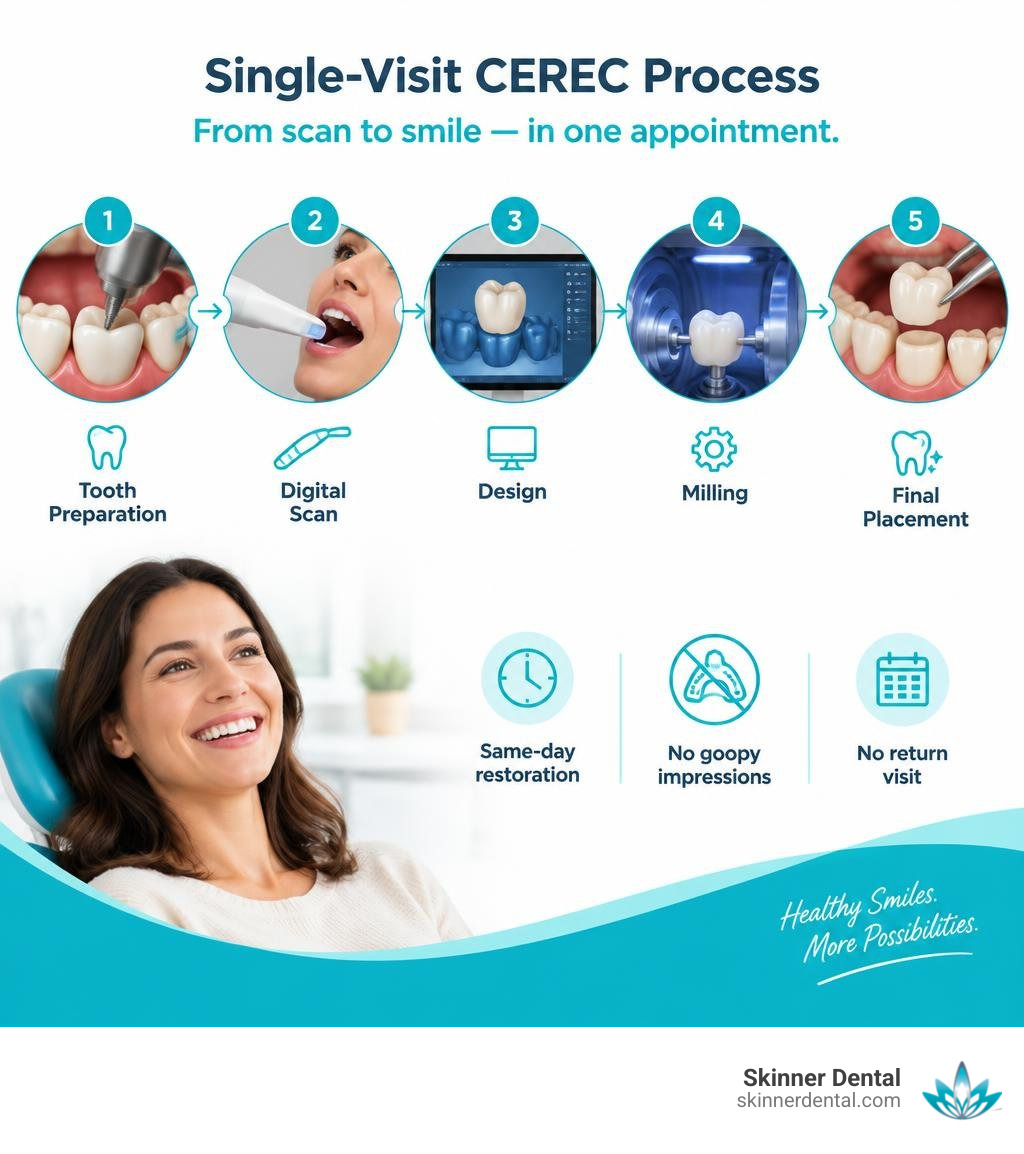
CEREC one-visit dentistry lets a dentist make and place a custom ceramic restoration in a single appointment. A small camera scans your prepared tooth, software helps design the restoration, and an in-office machine mills it to fit. For many crowns, that means no putty impression, temporary crown, or return visit.
A CEREC appointment often takes one to two hours, depending on the tooth and the material used. For busy Murray families, the biggest benefit is simple: less time arranging dental visits and more time getting on with the day.
What Is CEREC One Visit Dentistry and How Does It Work?
CEREC stands for Chairside Economical Restoration of Esthetic Ceramics (or simply Ceramic Reconstruction). Developed in 1985, this technology has evolved over more than three decades into a cornerstone of modern digital practice.
At its core, the technology relies on CAD/CAM (Computer-Aided Design and Computer-Aided Manufacturing). Instead of capturing an impression with gooey trays and mailing physical molds to a distant commercial laboratory, our team manages the entire fabrication process chairside (Sannino et al., 2014). Through optical imaging and high-precision subtractive milling, we design, carve, and place a custom ceramic restoration while you rest comfortably in the treatment chair.
For a comprehensive clinical perspective on how these components integrate, an overview of CAD/CAM chairside systems highlights how in-office digital workflows reduce treatment intervals while maintaining high aesthetic standards.
Understanding the Chairside CAD/CAM Technology Behind CEREC
The chairside system brings together three primary hardware and software units:
- High-Resolution Intraoral Scanner: A handheld digital wand captures thousands of optical data points per second. It generates an accurate, full-color 3D virtual model of your teeth, surrounding soft tissues, and dynamic bite alignment without messy alginate or polyvinyl siloxane putties.
- Interactive 3D CAD Software: Proprietary design software analyzes the virtual impression. It calculates the ideal anatomical shape, contact points, and chewing surfaces based on the natural architecture of your neighboring teeth.
- In-Office Precision Milling Unit and Induction Furnace: Once we approve the digital proposal, the design file transmits wirelessly to our chairside milling machine. Diamond-coated rotary burs sculpt the restoration from a solid monolithic block of medical-grade ceramic in minutes. If we use high-strength materials like zirconia or lithium disilicate, a specialized speed-induction furnace fires, glazes, and strengthens the restoration right in our office.
The Step-by-Step Clinical Workflow of CEREC One Visit Dentistry
Getting a custom restoration with cerec one visit dentistry follows a smooth, streamlined sequence:
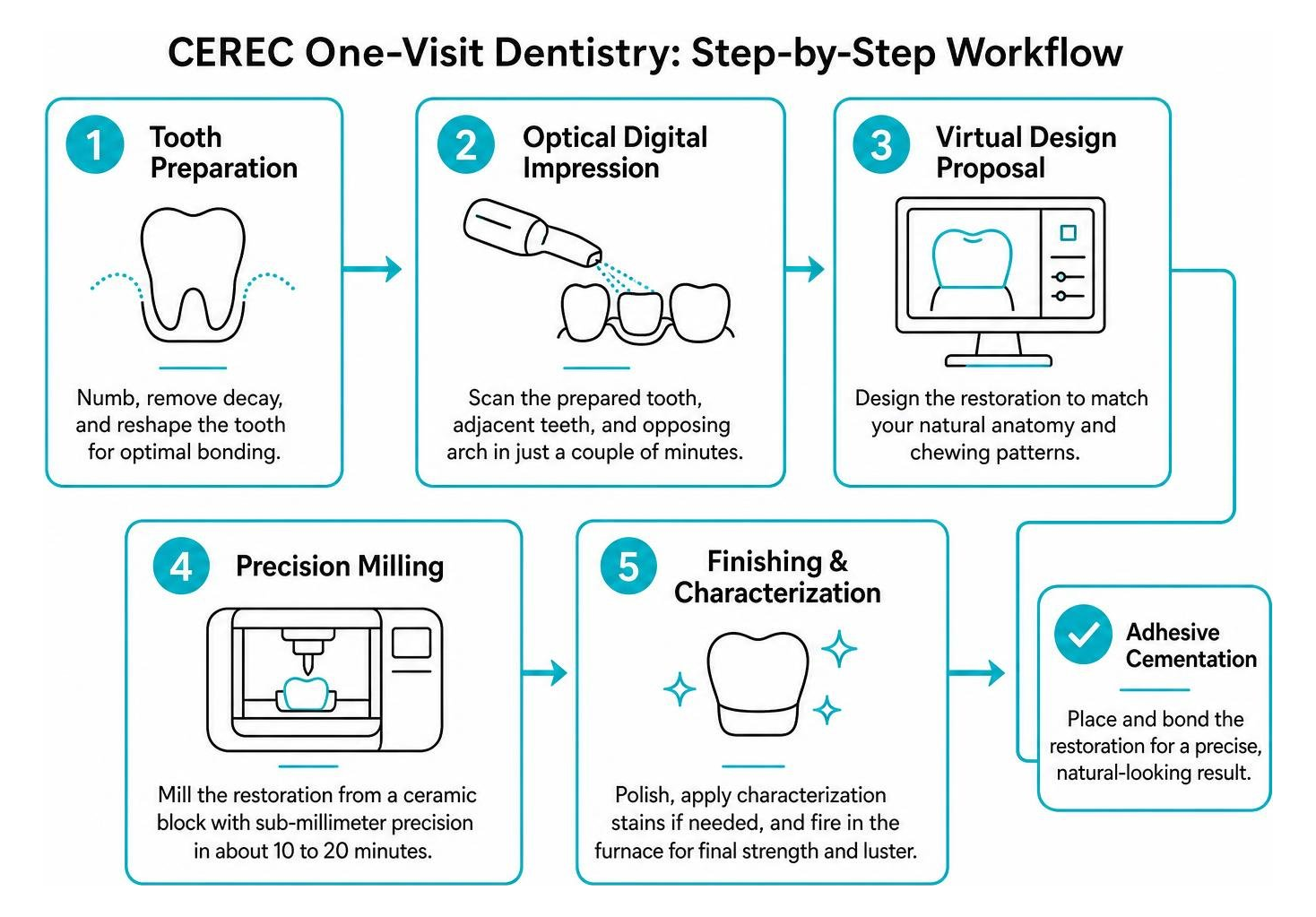
- Tooth Preparation: We numb the treatment area with local anesthesia, gently remove decay or damaged filling material, and reshape the tooth with smooth, rounded internal margins to support optimal ceramic bonding.
- Optical Digital Impression: We glide the intraoral scanner over the prepared tooth, adjacent teeth, and opposing arch. The scan takes only a couple of minutes and provides real-time verification of margin clarity.
- Virtual Design Proposal: Using biogeneric modeling software, we customize the restoration’s contours, occlusal grooves, and contact tightness to match your natural chewing patterns.
- Precision Milling: We insert a shade-matched ceramic block into the chairside milling unit. The machine carves the restoration with sub-millimeter precision in roughly 10 to 20 minutes.
- Finishing and Characterization: We polish the restoration, apply custom aesthetic characterization stains if needed, and place it into our rapid induction furnace for final crystallization or sintering.
- Adhesive Bonding: After checking the fit and bite, we treat the inner surface of the ceramic and bond it permanently to your tooth using high-strength resin cement.
Key Clinical Benefits: Why Patients Choose Same-Day Restorations
Around 85% of dental patients express a strong preference for single-visit restorative care. Completing complex dental work in one appointment removes the stress of taking multiple afternoons off work, coordinating childcare, or sitting through repetitive rounds of local numbing.
Comparing Single-Visit Restorations to Traditional Dental Lab Workflows
Traditional crowns require two distinct appointments spaced two to three weeks apart. During that interim period, you must wear a temporary acrylic crown that can loosen, break, or cause thermal sensitivity. Single-visit dentistry eliminates that waiting period entirely.
| Feature | Traditional Lab-Made Restoration | CEREC Single-Visit Restoration |
|---|---|---|
| Number of Appointments | 2 (spaced 2–3 weeks apart) | 1 single visit |
| Total In-Office Time | 2 separate appointments (60 min each) | 1 appointment (typically 90–120 min) |
| Impression Method | Physical impression trays with putty | Fast, optical 3D intraoral digital scan |
| Temporary Restoration Needed? | Yes (provisional crown for several weeks) | No (never required) |
| Local Anesthetic Injections | Multiple (required at both appointments) | Single visit, single numbing sequence |
| Turnaround Time | 10 to 21 business days | Completed in under 2 hours |
| On-the-Fly Adjustments | Requires mailing back to lab if fit fails | Digital design refined and re-milled chairside |
Eliminating Temporary Crowns, Putty Impressions, and Secondary Injections
For patients with a sensitive gag reflex, physical impression trays filled with heavy paste can be the most uncomfortable part of dental care. Digital optical scans bypass this step completely.
Furthermore, skipping temporary crowns protects your tooth. Provisional restorations are held in place with weak temporary cement, leaving the underlying dentin vulnerable to bacterial leakage, temperature sensitivity, and micro-movement. Sealing your prepared tooth with a permanently bonded ceramic restoration on day one preserves healthy pulp tissue and avoids a second round of injections weeks later.
Materials, Indications, and Clinical Longevity of CEREC Restorations
Single-visit restorations are carved from solid, biocompatible ceramic and porcelain blocks that closely mimic natural dental enamel. These metal-free materials resist plaque accumulation, remain gentle on gum tissue, and expand and contract with temperature changes at rates nearly identical to natural teeth.

Advanced Ceramic Materials: From Lithium Disilicate to High-Strength Zirconia
Modern chairside materials deliver exceptional mechanical strength alongside lifelike aesthetics:
- Lithium Disilicate (e.g., IPS e.max, CEREC Tessera): A glass-ceramic offering flexural strength between 360 and 700+ megapascals (MPa). Its high natural translucency makes it ideal for visible front teeth and premolars.
- Monolithic Solid Zirconia: An ultra-strong ceramic with flexural strength exceeding 1,000 MPa. Sintered in our chairside speed furnace, monolithic zirconia withstands heavy biting and grinding forces on posterior molars without risk of porcelain chipping.
- Feldspathic and Leucite-Reinforced Ceramics: Ideal for conservative inlays, onlays, and aesthetic veneers, these blocks allow fine shade blending and polish quickly without extended furnace cycles.
Restorative Versatility in CEREC One Visit Dentistry: Inlays, Onlays, and Crowns
While same-day technology is famous for full-coverage crowns, it also supports conservative, tooth-preserving options:
- Ceramic Inlays: Fit securely inside the cusps of a tooth to replace large, failing metal fillings.
- Conservative Onlays & Partial Crowns: Restore fractured or decayed cusps while leaving intact, healthy enamel undisturbed.
- Full-Coverage Crowns: Protect severely cracked teeth, deep structural decay, or teeth that have undergone root canal therapy.
- Aesthetic Veneers: Cover severe intrinsic discoloration, chips, or spacing irregularities across anterior teeth.
Frequently Asked Questions About Same-Day Dental Restorations
How long does a typical single-visit dental restoration appointment take?
A complete single-visit appointment generally takes between 90 and 120 minutes. While that is slightly longer than a standard checkup, your active time in the chair is limited. You can read, catch up on emails, or relax while our automated milling unit and induction furnace craft your crown.
Are same-day crowns as durable and long-lasting as lab-made crowns?
Yes. Peer-reviewed clinical studies show that single-visit CAD/CAM ceramic restorations achieve survival rates above 95% at 5 years and roughly 90% at 10 years, performing on par with traditional lab-fabricated porcelain crowns. Their monolithic structure means there are no weak, hand-layered porcelain borders prone to delamination or fracture.
What happens if a same-day restoration needs adjustments?
Because we control the entire digital design in our office, minor contact or bite adjustments are quick and easy. In the rare event that a restoration requires major structural changes, we can refine the 3D model and mill a brand-new crown during your visit—no multi-week delays or lab remakes required.
Conclusion
CEREC one-visit technology combines digital scanning, precision CAD design, and durable ceramic milling to provide high-quality restorative care in a single visit. By removing the need for messy impression trays, uncomfortable temporary crowns, and multiple rounds of anesthesia, same-day dentistry keeps your care fast, predictable, and comfortable.
At Skinner Dental in Murray, Utah, our team pairs this chairside CAD/CAM technology with gentle, personalized care for the entire family. Whether you need a cracked tooth repaired immediately or want to replace worn-out metal fillings, explore our full range of modern restorative dental solutions and fillings to restore your smile with comfort and confidence.
References
Sannino G, Germano F, Arcuri L, Bigelli E, Arcuri C, Barlattani A. “CEREC CAD/CAM Chairside System..” ORAL & implantology, 2014. PMCID PMC4402686.